




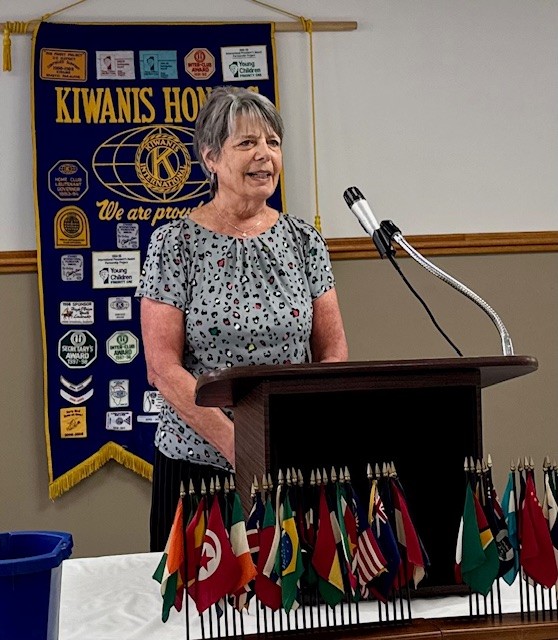
Caregivers give up a lot, and a lot of themselves, to be able to provide comfort and care of loved ones. Many times, they never saw themselves filling that role and it can lead to overwhelming feelings of guilt and stress. Terri Absher has walked the path herself and it led her to launch a local Caregiver Support Group. She talked to Kiwanis Thursday about her path and passion to give those who give a shoulder to lean on and an ear to vent to.
In 2010, my father was diagnosed with Alzheimer’s. We were living in West Virginia and at that time, there was not a caregiver support group in White County. So I thought, before we move back, that’s something I’m going to do. I went to the training and they asked everybody why they were doing it and I told them because of my father. They said, that’s really not a good idea if you’re going to be a caregiver. I said, well that’s not me, my mom is going to be the caregiver. I said it’ll be fine. So we got here and reality hit and I quickly understood why. You really can’t do that. Thankfully, Wabash stepped up about that time and got it going. My mom was able to benefit from that.
After her father passed away, a brother-in-law ended up needing a caregiver and her sister mentioned she really wish there was a group like when Wabash had the one for mom. After hanging up the phone with her sister, she realized something.
Why can’t it be you? So I had to go through the process again and got my credentials and we started a group in August of 2024. It started off with a bang and we’ve had some really good members.
While Alzheimer’s is a predominant source of need that the support group derived from, the group meets the needs of all caregivers. Absher says there are similarities that caregivers go through regardless of the patients’ illness and it makes a difference having a place where caregivers can come together and share honestly and openly what they’re going through.
Their guilts, frustrations, successes, misses, questions they have, asking about options, sharing resources, what works and doesn’t work. It’s for them to feel better because they can empathize with what each other is going through.
She says while many have been reluctant either because of it being a small town and the perception that everybody knows everybody, those who participate overwhelmingly are relieved to have the resource and to simply not feel so alone with the weight of burden.
For friends and family, she says the best thing you can do for a caregiver is to offer something specific rather than simply saying, “let me know if I can do anything”. That could look like picking up groceries or offering time so the caregiver can go to the doctor or take their pet to the vet. Help somebody wade through insurance paperwork and just help caregivers feel less isolated, which she says is a common feeling amongst those in the support group.
The group meets on the second Tuesday of each month from 6:30pm – 7:30pm at the SIC Carmi campus. That’s a change from previous meetings which were held over lunch.
We spoke with Absher and Sage Mitchell back in November. Listen to the Open Line for more. Find it at Open Line ON DEMAND – Caregiver Support Group with Terri Absher and Sage Mitchell – WRUL-FM